













Jeff Edwards is a retired U.S. Navy Chief Petty Officer, and an Anti-Submarine Warfare Specialist. He is currently working as a civilian expert consultant to the Fleet Anti-Submarine Warfare Command, the Navy's think tank for high-tech undersea warfare. His naval career spanned more than two decades and half the globe -- from chasing Soviet nuclear attack submarines during the Cold War, to launching cruise missiles in the Persian Gulf.
He puts his extensive experience as a Surface
Warfare specialist to work in his new novel,
TORPEDO.
In a plot that could easily be ripped from
today's headlines, TORPEDO combines an accident
at a nuclear power plant, an illegal arms
deal, and a biological warfare attack, to
ignite a crisis that could draw Western Europe,
the Middle East, and the United States into
all-out war. TORPEDO mixes the elements of
a classic sea chase novel with state-of-the-art
technology to create a cutting-edge Surface
Warfare Thriller.
TORPEDO is the winner of the 2005 Admiral Nimitz Award for Outstanding Naval Fiction.
Sound Off! Got an opinion about this article? Make your voice heard on the Jeff Edwards discussion forum.
Jeff Edwards contact info:
TheDeckPlate Website
Email Jeff Edwards
Jeff Edwards Books:
Torpedo: A Surface Warfare Thriller
Jeff Edwards Archives
Military Opinions Index
|
|
|
|
|
Your Two Cents
 Submit your stories, news items, or a benefits update -- and help Military.com bring the best, most important stories to your fellow servicemembers, veterans, and family members. Contribute here
|
|
|
July 29, 2005
[Have an opinion on this article? Go to the Discussion
Forum to sound off.]
When I was eight or nine years old, a car ran off a bridge embankment a few blocks from my school and slammed into a concrete abutment. My friends and I didn't see the accident, but we heard the screeching of tires and the crash of the impact. We also heard the police and ambulance sirens that came afterwards.
We gossiped and speculated the rest of the day, and several lurid accounts of the wreck began circulating around the playground. But I didn't learn any real details until the next morning, when a classmate of mine brought a newspaper clipping to share as a current event.
Three people had been in the car. Two of them, the driver and his wife, had been killed. Their teenage daughter had been rushed to the hospital with serious injuries. As it turned out, most of the details weren't too far out of alignment with our made-up stories. But our guesses regarding the cause of the accident were all wide of the mark. We had run through the usual list of suspects: swerving to miss a pedestrian; a blown tire; a drunk driver; all the possible causes we could imagine. Someone had even suggested vehicular suicide, but none of our theories were even remotely close to the story told by the girl who survived the crash.
A yellow jacket had flown into the car, right into the startled face of the driver. The yellow jackets where I come from are nothing to fool around with, and the driver had frantically tried to swat the little beastie before it could sting him in the face. Somewhere in the midst of all the thrashing and swatting, he had lost control of the car and crashed through a guardrail.
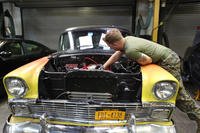
At the time, I mentally filed the incident under 'freak accident,' and let it go at that. It wasn't until years later that I began to recognize the fundamental irony at the heart of that car crash. An insect weighing a fraction of an ounce had killed two adult humans, and destroyed a half-ton of advanced machinery.
A few weeks ago, as I was trying to explain the concept of Asymmetric Warfare to a friend, that car accident came back to mind. Asymmetric Warfare describes any armed conflict in which a weaker or disadvantaged fighting force uses some special advantage to attack a superior fighting force. It's the metaphorical equivalent of leverage -- using a relatively small effort to create a disproportionately large effect.
There are a lot of legitimate uses for Asymmetric Warfare, from luring a state-of-the-art armored fighting vehicle into a pit/tank trap, to damaging a half a billion dollars worth of warship with an anti-shipping mine that costs a few thousand dollars. Perhaps one day I'll write a column about acceptable asymmetry. But right now, I want to discuss a darker application of the concept that is becoming far too common these days. Terrorists are often masters of Asymmetric Warfare, and they tend to focus their efforts on unsuspecting civilians, rather than lawful military targets.
The 9/11 hijackers were armed with little more than box cutters and rudimentary piloting skills, but they managed to kill three thousand people. If not for the extraordinary engineering of the twin towers, and numerous acts of exceptional heroism, the death toll could have easily been 30,000, or even 50,000. No doubt that was the intention of the attackers. But even the drastically reduced number is astoundingly high. Nineteen men with box cutters should not be able to massacre thousands. The asymmetry of that equation is so radical that it sounds impossible. But it is possible, as the entire world discovered on the day the towers fell.
The attack on the World Trade Center is not by any means the only recent example of Asymmetric Warfare. It's just the largest, and the easiest to identify. Many terrorist attacks fall into the category. The recent bombings in London and Egypt were certainly asymmetrical, as was last year's bombing of a Madrid train station. In all cases, the attackers were few, but the number of victims injured or killed was high.
Of course, when terrorists play the game, the actual carnage is only part of the result. The psychological effects of an asymmetric attack often extend to people who have no direct contact with the event or its physical victims. How many people are still too afraid to fly, in the wake of the 9/11 hijackings? How many citizens of London are too frightened to travel the underground, or board a double-decker bus? How many would-be vacationers are now avoiding the resorts at Sharm el-Sheik?
Terrorists are counting on the psychological impact of their attacks to magnify the significance of everything they do. There are a limited number of terrorists in the world, and they have a limited number of resources. Simple mathematics tells us that -- unless the majority of all people are terrorists -- we have the fanatics vastly outnumbered. Most people want peace, and security -- a chance to raise their families, pursue their own religious beliefs, and (hopefully) to contribute something useful to society and to mankind. Between them, the peace loving peoples of the world have more money, more food, more houses, more phones, more cars, more knowledge, more weapons, more everything than the terrorists.


|
As of this writing, the estimated population of planet earth is approaching six and a half billion people. The best estimates place the number of active terrorists at about 110,000, with about 6 to 7 million sympathizers who may be counted upon to provide some degree of passive or active support. If we lump them together and treat them all as active threats, the number of bad guys is something less than 7 and a half million. To give ourselves a degree of safety margin, let's double that. That gives us twice our worst-case estimate, or 15 million agents of terror. A little quick division tells us that terrorists are outnumbered 433 to 1, and -- remember -- that's assuming that our very worst-case assessments are off by half.
Stripped to its roots, terrorism isn't about danger. It's about the perception of danger. It's about creating the fear of attack, even when no real threat is present. According to the latest available figures from the CDC, terror attacks don't kill nearly as many people as Heart disease, Cancer, Stroke, Chronic lower respiratory diseases, Accidents, Diabetes, Influenza/Pneumonia, Alzheimer's disease, Nephritis, nephrotic syndrome, and Septicemia. In fact, on the index of significant statistical causes of death, terrorism doesn't even make the list. Last year, Alzheimer's alone killed more people than all the terrorist actions in the world.
Al-Qa'ida, Shining Path, HAMAS, the IRA, and Aum Shinri Kyo don't want you to think about that. They want you to focus on them . They want you to fear their bombs, and their bullets, and their gas, so that they can influence your actions. But the fact of the matter is, if every terrorist fanatic in the world steps up his or her efforts by a factor of ten, you're still more likely to die of Influenza or Pneumonia.
Does this mean that we can safely ignore terrorism? Not for a second. Does it mean that our enemies in the war on terror are somehow incompetent, or ineffective? Of course not. They're ruthless, they're murderous, and -- for the most part -- they are very very good at what they do. But what they do best is frighten people. In a world of six and a half billion souls, they have only the manpower and resources to threaten a miniscule fraction. To get to the rest of us, they must prey on the power of our media and our collective imaginations to amplify their importance until it is entirely out of proportion with their ability to inflict damage.
Let's look back to the car crash I discussed earlier. If the driver had not taken his hands off the wheel, what's the worse that yellow jacket could have done? It might have stung him somewhere tender, leaving him with a painful swelling for a few days. It might even have blinded him in one eye. But the man and his wife would have survived, and their daughter would have been spared the injuries of the crash.
The terrorists cannot win unless we let them frighten us into taking our hands off the wheel. Like the yellow jacket, their stings are nothing to sneer at. But we can keep our eyes on the road and our hands on the wheel, despite their venomous attacks. We have to. Because -- no matter how vicious their attacks become -- the insects who threaten us cannot drive the car. They can only destroy it.
© 2005 Jeff Edwards. All opinions expressed in this article are the author's and do not necessarily reflect those of Military.com.
|