














Coast Guard Takes Heat On Upgrade Plans
Associated Press
June 24, 2005
WASHINGTON - Lawmakers this week torpedoed the
Coast Guard's revised modernization plan and criticized
the agency's chief for supplying information late, and embracing a budget
proposal that does not provide enough money to expand his fleet.
The president's 2006 budget proposal only provides a marginal funding increase
for the Coast Guard, even though the agency's security responsibilities
significantly increased to include greater emphasis on ports, waterways, and
coastal security after Sept. 11, Republican and Democrat members of congress
said at a series of hearings this week.
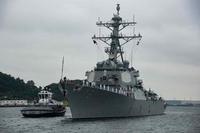
The Deepwater program, an 8-year-old plan to modernize the Coast Guard's naval
fleet, which ranks third oldest in the world, originally sought $966 million
from Congress for 2006, with support from both the President and the Office of
Management and Budget. But in mid-May, the House cut that figure by $466 million
because the Guard had not kept congress sufficiently informed about the
program's plans and progress.
Coast Guard Commandant, Admiral Thomas Collins, who has said that the proposed
cuts would cripple the Deepwater program, defended a revised implementation plan
before the House Appropriations Subcommittee on Homeland Security, but left the
hearing with his tail tucked between his legs.
"While the revised plan does meet the spirit of what we require," said
Congressman and Subcommittee Chairman Hal Rogers, R-Ky., it "includes four
different funding scenarios ranging in cost from $19 to $24 billion and from
20-25 years, each including a different acquisition schedule and mix of assets,"
or vessels, he said.
It is not Congresses' job to choose which plan is best, "we only dispose of
things, you propose," he told the Admiral. Rogers also stressed that Congress
cannot appropriate in ranges.
"We need to know how much you want and what you want to do with it. That is not
a difficult chore," he said.
The Chairman also critiqued the plan for failing to highlight how to best
address post Sept. 11 threats and what to do with the Guard's aging cutters --
or large boats -- and aircraft, which increasingly experience costly and
life-threatening mechanical failures.
The revised plan also fails to immediately address the approaching void in
patrol boats, which are dropping out of service due to hull breaches, Rogers
said.
Other Congressmen on the Committee were less gentle.
"I've never seen such a conglomeration of mumbo jumbo in all my life," Rep.
Marion Berry, D-Ark, said of the report, while Rep. Tom Latham, R-Iowa, said he
didn't think it was "worth the paper it's written on."
Collins insisted that "there was no attempt to be ambiguous," and defended the
Coast Guard's plan, saying that 20 years is a long time to plan ahead and that
the agency had wanted to give Congress more flexibility at a time when money is
short.
"The funding flow is uncertain from the Administration's perspective," Collins
said, and "there was an inability with any degree of certainty to predict the
cash flow."
He added that, "before we revised this we did not receive the President's
request for Deepwater."
Collins did push for the most expensive of the four plans however.
"My personal thought is that the default setting is the $24 billion in the upper
range," he said.
Rep. Jerry Lewis R-Calif., who is chairman of the full House Appropriations
Committee, made a surprise appearance at the hearing in what appeared to be the
role of the bad cop.
"These are difficult budget times and the appropriations pressure on all of our
subcommittees is not to be taken lightly," he said, "but I wanted to send a
message to those people who are behind you Admiral."
"Disconcerted" by comments made by members of the subcommittee regarding the
Coast Guard's lagging reports, Lewis warned Collins that, "it is not like other
people wouldn't like to do your job for you."
The Coast Guard has until July 14 to provide a definite plan on Deepwater, which
the subcommittee will discuss on July 21.
Sen. Olympia Snowe, R-Maine, chairwoman of the Senate Commerce Subcommittee on
Fisheries and the Coast Guard, also lashed out at the Coast Guard's revised plan
at a hearing last week, saying that everything seemed to have changed since
Sept. 11 except the Coast Guard.
The new plan "shockingly, says it actually needs fewer ships, planes, and
helicopters than before Sept. 11," Snowe said, noting that the Coast Guard's
original proposal had sought to enlarge its fleet.
"That violation of common sense is at the crux of today's hearing."
Snowe said technological improvements to the fleet are important, but are no
substitute for "actual, on-the-water presence."
She also criticized Collins for embracing the President's 2006 budget proposal.
However often Collins affirmed that "his men and women can get by" with what the
Administration has requested, she said, "the cold hard truth remains that the
Coast Guard is experiencing a record number of casualties and mishaps."
Collins responded to these critiques saying that the revised plan is "goal
driven," and "performance based" and should be judged by its results and not its
form. He cited record levels of cocaine interdiction last year as a sign that of
improvements in communications made by the Deepwater program.
Snowe also said she was disturbed by the "total absence of the word
acceleration" in the Coast Guard's revised plan. Shortening the time-frame for
acquiring Deepwater assets to perhaps a 10 or 15 year timeline would offer cost
savings of up to $4 billion over the life of the program she said, and would
protect the American people sooner rather than later.
A Government Accountability Office report of preliminary observations on
Deepwater released at the hearing found that the Coast Guard needs to better
prioritize its modernization plan, and hedge against gaps which will emerge as
certain assets are replaced or upgraded.
The report also warns that schedule slippages in replacements and upgrades which
have occurred already are signs that the Guard's acquisition approach needs
close monitoring.
The office's Director of Homeland Security and Justice Marget Wrightson,
presented the report to the subcommittee and said that the Coast Guard had not
implemented recommendations made by the Government Accountability Office over a
year ago.
Despite the expanded tasks given to the Coast Guard, Collins said that his
biggest challenge was to keep the Deepwater program "from sinking."
Sound Off...What do you think?
Join the discussion.
Copyright 2005 Associated Press. All rights reserved. This material may not be published, broadcast, rewritten or redistributed.
|