












WASHINGTON - Top U.S. military officer Gen. Richard Myers said Sunday there is no widespread pattern of abuse of Iraqi prisoners and that the actions of "just a handful" of U.S. troops at a Baghdad prison have unfairly tainted all American forces.
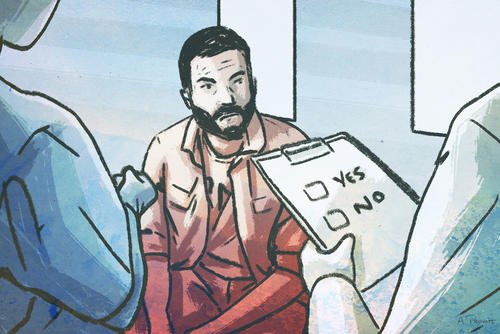
An internal Army report found that Iraqi detainees were subjected to "sadistic, blatant and wanton criminal abuses" at the Abu Ghraib prison near Baghdad, according to The New Yorker magazine, which said it obtained a copy of the report.
The abuses at the prison included threats of rape and the pouring of cold water and liquid from chemical lights on detainees, according to the published account.
Amnesty International said it has uncovered a "pattern of torture" of Iraqi prisoners by coalition troops, and called for an independent investigation into the claims of abuse. The London-based human rights group said it had received "scores" of reports of ill treatment of detainees by British and American troops.
The chairman of the Joint Chiefs of Staff said "categorically" that "there is no evidence of systematic abuse" in the U.S. detention operations in the region.
"We review all the interrogation methods. Torture is not one of the methods that we're allowed to use and that we use," Myers said. "I mean, it's just not permitted by international law, and we don't use it."
Six U.S. soldiers face courts-martial in the case. Myers said the six have been reassigned and are "essentially being detained while these investigations go forward."
Myers told ABC's "This Week" that he had not seen the 53-page report by Major Gen. Antonio Taguba that the magazine said it obtained. "I cannot comment on the veracity of that report," Myers said.
But, echoing comments last week by President Bush, Myers said, "It's really a shame that just a handful can besmirch maybe the reputations of hundreds of thousands of our soldiers and sailors, airmen and Marines who've been over there."
Myers said the Army is trying to determine whether military guards were encouraged to use such tactics in order to make prisoners disclose more information during interrogations.
"It's a good question, and we're looking into that part," Myers said. He said he would be "very surprised if there was somebody on the intelligence side saying, `Go do this,' because everybody knows that's wrong."
The Army investigation reportedly put a share of the blame for the abuses on military intelligence and private contractors.
Myers said contractors help as translators but always are under military supervision. "They're never on their own," he said.
The New Yorker report said intelligence personnel had set physical and mental conditions for interrogations.
On "Fox News Sunday," Myers said, "Setting physical and mental conditions for interrogation, by itself, that's something you do. What we don't do is we don't torture."
Myers said the United States should try to assure Iraqis that those Americans responsible for the alleged abuses "will be brought to justice. And that's what they should expect from us."
Myers also said, "I think we'll overcome it," when asked about the effect of the scandal on U.S. efforts in Iraq.
Lawmakers said that may take time.
"I hope that the incredible damage this situation has cause will be somewhat counterbalanced by the millions of acts of kindness and generosity and sacrifice that American soldiers have made in Iraq, for the Iraqi people," said Sen. John McCain, R-Ariz.
Since photographs were televised last week of the treatment by military personnel of Iraqi prisoners, the subject has caused widespread revulsion and outrage not only among Iraqis but throughout the Arab countries.
"Everybody understands the phenomenal damage this accusation has caused in that part of the world," said Delaware Sen. Joseph Biden, ranking Democrat on the Senate Foreign Relations Committee.
He was disturbed by the fact that Myers has not seen the report.
"I don't get the sense that they understand what an incredible sense of urgency there is here," Biden said.
"No one's going to believe in the Arab world, no one's going to believe in Europe, ... many people are not going to believe in the United States of America, that in fact we are earnest about this.
"This is the single most significant undermining act that's occurred in a decade in that region of the world in terms of our standing."
Sound Off...What do you think?
Join the discussion.
Copyright 2004 Associated Press. All rights reserved. This material may not be published, broadcast, rewritten or redistributed.