






Home
Benefits
News
entertainment
shop
finance
careers
education
join military
community
 
Search for Military News:  
Headlines News Home | Video News | Early Brief | Forum | Passdown | Discussions | Benefit Updates | Defense Tech
3,200 Marines Prepare for Afghan Tour
Associated Press  |  January 15, 2008
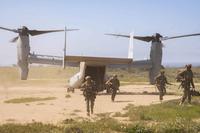
WASHINGTON - Military officials said Jan. 14 that about 3,200 Marines are being told to prepare to go to Afghanistan - a move that will boost combat troop levels in time for an expected Taliban offensive this spring. The move also comes as NATO allies have balked at increasing their own troop levels in Afghanistan.

Once complete, the deployment would increase U.S. forces in Afghanistan to as much as 30,000, the highest level since the 2001 invasion after the terrorist attacks on the World Trade Center and the Pentagon.

The notices come as explosions rocked Kabul's most popular luxury hotel Monday, killing at least six people, including one American and a journalist from Norway. Officials said the assault on the Serena Hotel by militants may signal a new era of Taliban attacks.

The military began notifying the Marines and their families over the weekend, as Defense Secretary Robert Gates was expected to sign the formal deployment orders. It was not clear Monday whether the orders had been signed yet.

The proposal went to Gates on Friday, and while he told reporters that afternoon that he had some questions about the move, there has been every indication he was poised to approve it.

According to officials, 2,200 members of the 24th Marine Expeditionary Unit, based at Camp Lejeune, N.C., will go to Afghanistan, as well as about 1,000 members of the 2nd Battalion, 7th Marine Regiment, which is based at Twentynine Palms, Calif.

The officials spoke on condition of anonymity because the deployment announcement has not yet been made. If approved, the deployment to southern Afghanistan would be a "one-time, seven-month" assignment, Pentagon Press Secretary Geoff Morrell said Friday.

The 2nd Battalion, which is from the Marine Corps Air Ground Combat Center, is an infantry unit, and it will be used largely for training Afghan forces.

The decision to increase U.S. troop levels in Afghanistan represents a shift in Pentagon thinking that has been slowly developing in recent months. Commanders faced with increasing violence have said they need as many as 7,500 more troops, but Gates initially pressed for other NATO nations to fill the void.

NATO countries, however, faced public opposition to deeper involvement there and were slow to respond, leaving Gates to acknowledge recently that the U.S. may have to consider providing the extra combat troops.

Currently, there are about 27,000 U.S. troops in Afghanistan, including 14,000 with the 26-nation NATO-led coalition. The other 13,000 U.S. troops are training Afghan forces and hunting al-Qaida terrorists.

Another reason for the planned infusion of Marines is the failure of U.S. pressure to persuade European allies to fill shortfalls have failed to produce sufficient combat units for Afghanistan's dangerous southern and eastern provinces.

Some at NATO headquarters suggest the Bush administration also hopes a surge in the number of well-trained, well-equipped U.S. troops can hurt the Taliban and bring some good election-year news from Afghanistan, just as U.S. President George W. Bush's decision to send more troops to Iraq has received credit for improvements there.

However Washington's failure to find allies to do the job also reflects on the administration's lack of clout in some European capitals and public misgivings in key allies such as France, Turkey, Germany, Italy and Spain about America's war on terror.

"There would be strong public reaction if a single soldier were killed in what is essentially seen as a U.S. war against Taliban or al-Qaida," said Gokcen Ogan, of the Ankara-based think tank Eurasia Strategic Research Center.

Germany and Italy are among the biggest contributors to the NATO force, but have barred their troops from fighting the Taliban in the front-line southern provinces, keeping them instead in the relatively peaceful north and west to provide security for reconstruction efforts.

Prime Minister Romano Prodi faces persistent calls from left-wing parties within his own coalition for a withdrawal of Italy's 2,550 troops. The German government has resisted opposition calls to pull out its over 3,000 soldiers. To maintain parliamentary support, it underscores the troops' role in supporting development, rather than accepting an expanded combat role, which polls indicate would be unpopular.

Fear of casualties, and commitments to military missions in Africa, the Balkans and the Middle East, have added to some Europeans' reluctance to send more troops to Afghanistan.

That refusal to deploy to the most dangerous parts of the country has opened a rift with NATO allies such as Britain, Canada and the Netherlands who, along with the United States, have borne the brunt of the renewed Taliban violence in the south.

Some of those nations have a bigger proportional contribution to NATO's International Security Assistance Force than even the United States. With 7,750 troops, Britain has 4 percent of its troops in Afghanistan according to NATO figures. Denmark has 3.5 percent, the Netherlands 2.9 percent and Canada 2.6 percent.

The U.S. has 1.1 percent of its troops serving with the alliance force in Afghanistan, the NATO data shows.

U.S. Defense Secretary Robert Gates last month acknowledged the political difficulties faced by European governments and suggested a switch in Washington's tactics for procuring more support.

"Continuing to publicly go after our allies for things that -- to do things that politically are just impossible for them is probably not very productive," he told reporters after a meeting with key allies in Scotland. "Many of these governments are minority governments; they're coalition governments; their position is fragile."

U.S. diplomats are working with European allies to prepare a revised political strategy on Afghanistan for an April summit of NATO leaders in Bucharest, Romania. It is expected to place greater focus on the need to combine military and civilian efforts in Afghanistan, boosting economic development and improving governance by building up the Afghan police and judiciary. NATO experts are also hoping the summit will boost efforts to train the Afghan army, which they see as key to an eventual reduction of the international force.

Officials hope the Bucharest message could persuade allies to increase contributions.

NATO military planners already see some signs of movement. They point out that France recently agreed to redeploy Mirage warplanes from Tajikistan to a NATO base in southern Afghanistan, and send French military experts into the south for the first time to help train Afghan army units.

President Nicolas Sarkozy on a visit to Kabul last month hinted that France's contingent of 1,300 could be further strengthened.

The Dutch government agreed in November to keep its troops - currently around 1,500 - in volatile Uruzgan province for two more years. NATO officials are confident a government-commissioned report due out next week in Canada will recommend maintaining its 1,700 troops there.

NATO diplomats are hopeful Britain will increase its contribution in Afghanistan as it downscales operations in Iraq. Poland recently announced it would add 400 troops and eight much-needed helicopters to its contingent of 1,140, despite an opinion poll in December that showed 83 percent of Poles opposed their county's participation.

The poll carried out by the CBOS institute gave a margin of error of plus or minus three percentage points.

Analysts say Turkey - which has NATO's second-largest military - may agree to do more if it receives U.S. support against the PKK rebel bases in northern Iraq and on other international issues.

"If there were satisfactory developments in important foreign policy issues, like on the PKK issue, or on the Cyprus issue, the government would be able to exert more pressure on the military to expand activities in Afghanistan," said security expert Ogan.

Sound Off...What do you think? Join the discussion.

Copyright 2012 Associated Press. All rights reserved. This material may not be published, broadcast, rewritten or redistributed.


Search for Military News: