This article is provided
courtesy of Stars & Stripes, which
got its start as a newspaper for Union troops
during the Civil War, and has been published
continuously since 1942 in Europe and 1945
in the Pacific. Stripes reporters have
been in the field with American soldiers,
sailors and airmen in World War II, Korea,
the Cold War, Vietnam, the Gulf War, Bosnia
and Kosovo, and are now on assignment in the
Middle East.
Stars and Stripes has one of the widest distribution
ranges of any newspaper in the world. Between
the Pacific and European editions, Stars
& Stripes services over 50 countries
where there are bases, posts, service members,
ships, or embassies.
Related Links:
Current
Archive
Stars
& Stripes Website
Sound
off in our Discussion Boards
Have an opinion on the issues discussed in
this article? Sound off.
Get
Breaking Military News Alerts
|
|
|
Your service may have earned you great education
benefits. Get over $1000 per month to pay
for your undergraduate, graduate or technical
degree.
Find military-friendly schools today.
|
|
|
|
December 28, 2004
[Have an opinion about the issues discussed in this article?
Sound
off in our Discussion Boards.]
By Joseph Giordono,
Stars and Stripes Mideast edition
 |
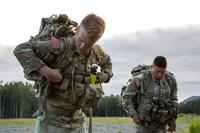
| (Photos by Joseph Giordono / S&S) Staff Sgt. Feliberto Rivera,
left, and Sgt. Javish Rosa, both of the 1st Battalion, 69th
Infantry Regiment, clear buildings in a farm compound near Taji
on Christmas Eve. |
 |
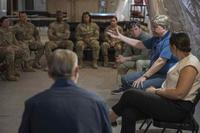
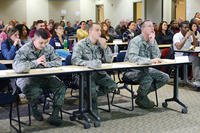
| Lt. Col. Geoffrey Slack, 1st Battalion, 69th Infantry Regiment
commander, talks with two local sheiks during a regional council
meeting in Taji, Iraq. Local leaders say security is still the
most important issue to be resolved. |
 |
| Capt. Martin Ortiz of the 1st Battalion, 69th Infantry Regiment
hands out toys to children at a farm compound near Taji, Iraq.
|
 |
| An Iraqi boy jumps up to get a look inside a parked U.S. armored
vehicle in Taji, Iraq. |
 |
| Soldiers from the 1st Battalion, 69th Infantry Regiment ask
local residents about a trench found in a palm grove outside
of Taji, Iraq. Soldiers say the trench could have been either
a fighting position or a hiding place for a weapons cache. |
TAJI, Iraq
— Local leaders in this mostly rural area on the outskirts of Baghdad
are telling U.S. military commanders that security is still the
most important issue to be resolved.
Military officials largely agree, and say the fastest fix is to
get more cooperation from those same leaders and townspeople in
ongoing efforts to root out insurgent fighters.
Last week, several battalion commanders and civil affairs personnel
from the 256th Brigade Combat Team who patrol the Taji region sat
down with local Iraqi officials at a khada, or regional council
meeting. Working through the morning, the two groups exchanged thanks,
sought information and worked to find common ground.
“If you point out to me who the bad guys are, I will capture or
kill them,” Lt. Col. Geoffrey Slack, commander of the 1st Battalion,
69th Infantry Regiment, told the council members. “We want your
input to improve the security picture.”
U.S. officials say the Taji area could be particularly important
because it lies between Baghdad, Fallujah and Mosul, cities that
have become centers of the months-long insurgency. Military leaders
say insurgents pushed out in last month’s offensive in Fallujah
could be training or seeking refuge in the area.
At the khada, local officials echoed those sentiments.
“If you secure this area, you can make Baghdad more and more safe,”
one of the council members said through an interpreter. Insurgents
have already threatened many on the council, he said.
One of the difficulties, the Iraqi leaders said, is that new U.S.
units continually rotate through the local area, bringing different
methods and troops than previous units. One council member said
he has met with five different U.S. commanders since June 2003.
Some soldiers have the same complaint, saying they are sometimes
only in one area long enough to get to know the local population,
then are moved.
“The vast majority of people here are on the edge,” Slack, a direct
and plain-spoken Long Islander, said in an interview earlier in
his command post. “They aren’t sure yet whether working with the
coalition is a good thing or bad thing.”
Insurgents have warned the local population against cooperating
with the U.S. military and have attacked troops with roadside bombs
on several routes throughout the area. In addition, Slack said,
criminals have harassed truck drivers and other merchants.
Meeting with local political leaders and sheiks is one of the tactics
to find the fighters, who council members claimed were largely foreigners.
Another tactic is patrolling the countryside.
On Christmas Eve, a day after the council meeting, the unit sent
out several patrols. One, a convoy of armored vehicles riding along
one of the many irrigation canals around Taji, stopped in a palm
grove near a farm complex.
The soldiers quickly searched the buildings. Then they asked the
residents — nearly two dozen women and children and one teenage
boy — about the situation. The people in the compound said they
had enough gas to run their generator only 30 minutes a day.
Sgt. Javish Rosa, 25, of New York City, said the compound reminded
him of Afghanistan, where he served an active-duty tour with the
10th Mountain Division. Rosa surveyed the scene, quietly slipping
pieces of candy to the children.
The family offered the soldiers tea, and the troops returned with
a box full of presents — stuffed animals, plastic flutes, crayons
and other gifts. The encounter ended with smiles all around.
Out in the palm grove, soldiers discovered freshly dug trenches
that could be either fighting positions or used to hide recently-unearthed
weapons caches. Insurgents have been known to bury munitions in
outlying areas before digging them up to use in later attacks on
U.S. troops, military officials have said.
But Friday, as is often the case, all of the people living nearby
said they didn’t know how the trenches were used or who dug them.
Email
this page to friends
©2004 Stars & Stripes. All opinions
expressed in this article are the author's and do not necessarily
reflect those of Military.com.
|