This article is provided
courtesy of Stars & Stripes, which
got its start as a newspaper for Union troops
during the Civil War, and has been published
continuously since 1942 in Europe and 1945
in the Pacific. Stripes reporters have
been in the field with American soldiers,
sailors and airmen in World War II, Korea,
the Cold War, Vietnam, the Gulf War, Bosnia
and Kosovo, and are now on assignment in the
Middle East.
Stars and Stripes has one of the widest distribution
ranges of any newspaper in the world. Between
the Pacific and European editions, Stars
& Stripes services over 50 countries
where there are bases, posts, service members,
ships, or embassies.
By Rick Emert, Stars and Stripes European Edition
BAGHDAD — The 2nd Medical Brigade, which oversees nearly all medical operations in Iraq, is chipping away at the barrier that keeps soldiers from seeking treatment for combat stress.
It's a fight Army social workers, psychologists and psychiatrists have been waging since post-traumatic stress disorder came into the spotlight following the Vietnam War.
A recent post-deployment screening conducted by the U.S. military showed that more than 50 percent of servicemembers were reluctant to seek treatment for combat stress because they feared it would affect their careers or future promotions.
But members of the brigade's Mental Health Section and the 785th Combat Stress Company say nearly all cases that are treated never even go into a soldier's medical file, let alone his personnel record.
"We don't upload their file to the promotion board to be looked at," said Maj. Geoffrey Grammer, medical director for the 785th Combat Stress Company in Baghdad. "We're not going to destroy careers. [Information] is kept in our files, but it is confidential. It does not go into their personnel file."
Of course, commanders and even peers may know that a soldier was treated for combat stress.
"Yeah, the commanders know," said Col. Bob Evans, senior clinician for the 785th Combat Stress Company. "A lot of them are appreciative of what we can do to help their soldiers. They become proud of the soldier's achievements."
More than 95 percent of all soldiers treated for combat stress, which includes stress caused by family problems or even fatigue, return to duty in a matter of days.
"[The commanders] see somebody whose performance has suddenly gone way up, and say: 'Wow, you really fixed this guy,'" Evans said.
In most cases, like that of Staff Sgt. Richard Williams, a maintenance section chief from the 1st Cavalry Division, the soldier is returned to the same position he held before treatment.
Only in rare cases where a soldier poses a threat to himself or others would he be placed in a different section or status, such as under suicide watch or deemed unable to carry a weapon, Evans said.
There are two to five reported suicides each month in Iraq, Grammer said. According to an Army report released in March, 24 soldiers deployed to Kuwait and Iraq committed suicide in 2003 — a rate of 17.3 per 100,000. The overall Army suicide rate during the same time period was 12.8 per 100,000 soldiers.
Williams was suffering from anxiety attacks, a condition he had before he deployed to Iraq.
"I had experienced this before but dealt with it," Williams said. "It was becoming difficult to concentrate. I became aware that my work performance was suffering."
Williams first talked to a chaplain, who suggested he try medication. He went to a nearby medical clinic and was put on the wrong type of medication.
After spending a night at the 785th Combat Stress Company's fitness center, and getting the correct medication, Williams was able to return to duty.
The fitness center refers more to mental fitness than physical. Soldiers spend up to five days at the center for treatment and follow a scheduled routine of physical training, chores and relaxation in a less intense environment.
Williams admitted the first step to recovery was a big one.
"It was easy to preach to my soldiers that they can get help, but it was not so easy taking my own advice," Williams said. "I was being a tremendous hypocrite. I had told my soldiers that it was nothing to be ashamed of or embarrassed by."
Returning to his unit after treatment was awkward, but Williams said he quickly got back into the swing of things.
"People looked at me funny for a day or two," he said. "I went up to each of my soldiers individually and explained my situation. It actually brought the team closer together. We're still a maintenance team, but we're also a support group. We're able to talk to one another about these issues that everybody here has."
Williams is one of many success stories of the mental health staffs throughout the theater. But other would-be successes are not coming forward with their problems. The 2nd Medical Brigade and combat stress companies are trying to change that by reaching out to the soldiers.
In an average 72-hour period, combat stress staffs throughout Iraq will conduct about 180 walkabouts, where they meet with about 700 soldiers and talk to them as a preventive measure. That does not mean the staff treats that many soldiers, only that it speaks to them to get a feel for how things are going.
"We get out there to make ourselves more approachable," Grammer said. "If the soldiers know us by name and face, they are more likely to come by and talk to us. The biggest focus for us is seeing the people at all."
The staff members see about 88 command referrals during a typical 72-hour period, according to Capt. Jeffrey Greenlinger, a social worker with the medical brigade's Mental Health Section. Those are cases in which soldiers are referred for treatment by their commanders.
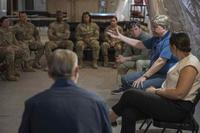
The staff also conducts classes on combat stress symptoms and relaxation techniques during that time, Greenlinger added.
A group of 12 mental health professionals visited the theater last year and identified ways to improve the situation here.
Among them was bringing in the 1908th and 1835th Combat Stress detachments to add about 60 mental health professionals to the 60 from the 785th already in Iraq.
The 2nd Medical Brigade also created the Help 4 Web site, at www.mnf-iraq.com/2ndmed/index.htm, to link soldiers up with the nearest mental health resources available to them.
The combat stress staffs have spent months talking to commanders, platoon sergeants and section chiefs about getting soldiers the treatment they need.
Apparently, the word is getting out to the troops, like Sgt. Joseph Alonso, 478th Civil Affairs Battalion, and Spc. Christopher Sebren, 1-244th Command Aviation Battalion from the Louisiana National Guard.
"I haven't gone through combat stress; so far, things are going pretty good," Alonso said.
"The [rest and recuperation] trips help, and the unit takes pretty good care of us."
But, Alonso added, he knows how to get help if he needs it.
"The command keeps us pretty well informed of numbers we can call for help," he said.
Sebren said he has experienced stress during events such as mortar attacks, but it subsides.
"After a few minutes it hits you what really just happened, but you try not to think about it too much," he said, adding that he would seek treatment if he felt the need, and that he was aware of whom to contact for help.
"It's no problem to find help here," he said.
Mental health staff members go out to even the most remote areas.
"We go in and develop relationships with the soldiers," said Maj. David Rabb, 785th Combat Stress Company commander. "Stress is the silent enemy that can take people down. It's important that people do not isolate themselves."
"It is like PMCS [a system of maintenance checks performed on Army vehicles] for soldiers," Evans said. "You can't run a Humvee all day long and expect it to keep going. Likewise, you can't run a soldier 12 hours a day for seven days a week and expect him to hold up."
Email
this page to friends