Navy's Reserve Will
Be Integrated with Active Forces
By Rear Admiral David O. Anderson and Rear Admiral J. A. Winnefeld,
U.S. Navy
Proceedings, September 2004
RESERVES FROM MOBILE INSHORE UNDERSEA WARFARE UNIT 108
PATROL KUWAITI PORT / U.S. NAVY
To meet the national security challenges of the 21st century, the Navy
must maximize the effectiveness of all its assets—installations, ships,
aircraft, and people—active and reserve. Integration is a priority,
and the first step is determining fleet requirements for reserve capabilities.
In the post-Cold
War world, most naval professionals take for granted that investments
in platforms, systems, people, and training must be oriented to address
asymmetric threats, rapid changes in technology, globalization, and
new business realities. These 21st-century warriors live in a world
of fast, adaptable, networked forces that must maintain high states
of readiness and employ precision weapons with integrated joint and
coalition partners. Shifting national demographics, the demands of a
more technically oriented force, the high operating tempos of the global
war on terrorism, and a tight fiscal environment create new challenges
for the way our Navy is manned. Thus, it should surprise no one that
Chief of Naval Operations Vern Clark directed our Navy to take a fresh
look at the role of the Navy’s Reserve and how it integrates with the
active forces to operate in this new environment.
The Navy’s reserve component (RC) was structured for the Cold War and
designed around large-scale mobilizations and relatively slow response
times enabled by adequate warning timelines. Over the years, the RC
experienced “mission creep” by accepting roles not originally envisioned
for reserve forces. Meanwhile, the active component (AC) managed its
RC largely by benign neglect, because the reserve operating model simply
did not fit with how the Navy operated. The global war on terrorism,
with its greater emphasis on use of reserve forces in specialty roles
and to sustain the overall effort, demands that the Navy have the right
reserve capabilities. It became imperative to restructure and reintegrate
the Navy’s Reserve into the Navy—to create a properly aligned and integrated
total force designed to provide the capabilities outlined in “Sea Power
21” and to support the Fleet Response Plan.
The key step in achieving active-reserve integration is to determine
what the AC really needs its RC to do and when the RC needs to do it.
Accordingly, last year Admiral Clark tasked Fleet Forces Command to
conduct a review of all reserve capabilities required by the AC. This
zero-based review laid the groundwork for a more integrated total force
in which RC functions directly support “Sea Power 21” missions. Admiral
Clark was briefed on the process and product of the review in August
2004.


|
The zero-bsed review systematically studied gaps in AC capabilities
that should be filled by the RC. Cost and risk values were assigned
to each validated reserve capability relative to the active-duty mission
so senior leaders could make informed decisions on the appropriate levels
of investment. The result was a blend of existing and new capabilities,
and some were recommended for realignment or divestment. The review
acknowledged two essential types of support the AC will receive from
the RC: (1) the Navy has needs that are best filled by discrete units
that stand up when required to provide a specific capability, and (2)
there is a clear need for individuals or portions of units that can
augment existing active commands. Nearly every validated capability
is designed to increase the warfighting capacity of the active force.
The new validation concept is simply what the AC needs to have, not
just what is nice to have.
Activities and commands are now coordinating with claimants and resource
sponsors to develop a multiyear transition plan to align their manning
requirements to these approved RC functions. In addition, Fleet Forces
Command will be conducting an analysis of existing and future joint
requirements. As the culture change required by active-reserve integration
begins to take hold in the AC, new opportunities for integration that
truly increase the capacity of the active force will emerge that must
be addressed.
The Way Ahead
This means the AC will take ownership of the readiness of the RC, with
individual active-duty commanding officers clearly understanding they
are responsible for the readiness of their supporting reserve forces.
The AC will define what training levels the RC will meet, apply metrics
to the required RC readiness levels, and oversee RC training.
 |
|
U.S. NAVY (B. W. SCHULTZE)
|
|
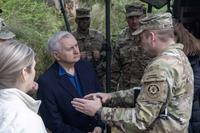
The message is getting out. Master Chief Petty
Officer of the Navy Terry Scott (left) answers questions on reserve-active
integration in Al Asad, Iraq. Naval Reservist Hospital Corpsman
Second Class Ilisa Kleifield (right) appears to have deploying
to Iraq in a positive perspective as she bids her mom good-bye
in July.
|
 |
|
U.S. NAVY (M. WORNER)
|
Good communication is vital to active-reserve integration. The RC has
been very successful over the past year in informing its members about
the new obligations this integration brings and the Chief of Naval Operations’
vision for a total force. It will take strong, involved leadership to
ensure our active-duty commanders and commanding officers understand
and embrace the notion that their supporting reservists are a daily
responsibility and force multiplier. Cultural acceptance on the part
of the AC will lead to even stronger acceptance on the part of the RC.
A fully integrated active and reserve force will exist only when the
AC and RC break through many of their paradigms of the past and realize
the art of the possible.
We also must adjust the supporting bureaucracy and structure to eliminate
impediments that restrict AC access to its RC. The Navy needs to be
able to tap the military and civilian skills that reside within the
reserve forces, and the RC must demonstrate flexibility to meet the
capabilities required by the fleet. This will mean finding new ways
to structure and fund how the reserves are tied to the active force.
It is clear that the days of drilling 2 days per month and 14 days per
year at a reserve center or conducting convenient exercises are over.
We are now a surge Navy, which means that when we need the reserve forces,
they must be ready. The message for the reservists is that they need
to be prepared to mobilize one or more times during a career—or consider
finding a different part-time job. Again, effective communication is
critical. As long as families and employers of reservists know their
serving family members and employees are making a difference in our
nation’s security, they will be much more supportive about the reservists
deploying. A deployment may be for 30 to 60 days of operational support
or it may be for 6 months to 12 months of mobilization.
To support this new construct, RC units requiring tactical skills eventually
will be located in the fleet concentration areas. Reserve capabilities
in the nation’s heartland will focus on skills that are not perishable
or that do not require frequent training with the AC to achieve tactical
proficiency. The RC structure in the heartland will fill more of the
Navy’s joint requirements to support the Northern Command and the Strategic
Command.
There will be cultural obstacles to active-reserve integration, particularly
in areas where the most dramatic changes will occur. It may be years
before reserve force integration will be routine. However, the long-overdue
focus of this integration will transform the Navy’s Reserve into what
it was intended all along to be: a valuable force multiplier for our
Navy.
Admiral Anderson is Director for Force Integration and Admiral Winnefeld
is Director for Warfare Programs and Requirements, Fleet Forces Command.
| Join
the Naval Institute, a membership association for Navy,
Marine Corps, and Coast Guard professionals and anyone interested
in the sea services. Benefits include a subscription to Proceedings
magazine, discounts on books, magazines and gifts, and access to
the world's largest private ship and aircraft photo library. |
© 2004 U.S. Naval Institute. All rights reserved.