This
article is provided courtesy of DefenseWatch,
the official magazine for Soldiers For The
Truth (SFTT), a grass-roots educational organization
started by a small group of concerned veterans
and citizens to inform the public, the Congress,
and the media on the decline in readiness
of our armed forces. Inspired by the outspoken
idealism of the late Colonel
David Hackworth, SFTT aims to give our
service people, veterans, and retirees a clear
voice with the media, Congress, the public
and their services.
|
|
|
|
August 16, 2005
[Have an opinion about the views expressed in this article? Sound
off in the Hot Issues with Defensewatch Forum.]
By Nathaniel R. Helms and Ray Perry

DSRV Mystic loading aboard Russian civilian Anatov AN-124 Condor during Operation Pacific Reach in 2004. USN Photo |
|
The barely averted tragedy deep under the ocean off the coast of eastern Russia last week raised the question of how well prepared the U.S. Navy is to rush to the rescue of one of its priceless crews in a $1.8 billion attack submarine or an almost $3 billion Trident -class missile boat on the bottom of the deep, black sea.
When the tiny Russian AS- 28 Priz deep submergence rescue submarine and its seven crewmen last week became tangled up with undersea cable in more than 625 feet of water the Russian Navy was helpless to save them and was forced to call for international help. At the time of Russia 's clarion call a day after discovering the emergency the desperate crew had a day's worth of air left to breath, the Russians announced.
Only five years before, on Saturday, August 12, 2000 , the giant Russian nuclear submarine Kursk - carrying a crew of 118 - sank in the icy waters of the Barents Sea after a catastrophic accident. It took more than a week for divers to open the rear hatch and confirm everyone inside was already dead. This time the Russians, still stinging from criticism for not seeking help to save the crew of the Kursk , didn't wait to call for help and still it was a very close thing. By the time British Submarine Rescue sailors freed the Priz's crew in a dramatic international effort the seven men were down to less than six hours of air, Russian officials said.
If a similar disaster struck an American submarine is the U.S. Navy is capable of saving the crew from a lonely, gruesome death? To find out DefenseWatch asked three experts in underwater rescue operations what the U.S. Navy was doing to ensure it was ready to meet any undersea disaster. All the experts including Capt Thomas J. Eccles, Program Manager, Advanced Undersea Systems for the U.S. Navy, Chuck Maclin, Submarine Rescue Operation Manager for Maryland-based Phoenix International and Tim Jainatis, its vice-president for operations, agreed the Navy was perfectly capable of mounting a rescue effort.
But whether it is equally prepared to do so is another kettle of fish. Just last year during an international submarine rescue exercise conducted in South Korea the Navy had to rent a giant civilian Russian Anatov AN-124 "Condor" transport plane to deliver the 38-ton Deep Submergence Rescue Vehicle (DSRV) Mystic , the Navy's premier rescue vessel because there wasn't an American military airplane available. The DSRV is portrayed as being so mobile it can be in anywhere on the globe in 36 to 48 hours. However, when it was time to ship the 49-foot long vessel to South Korea all of the U.S. Air Force's Lockheed C-5 Galaxy's capable of carrying the mini-sub were unavailable due to USAF commitments in support of the Global War On Terror, the Navy said.
A retired submarine skipper who talked with DefenseWatch and who has a working knowledge of Navy rescue procedures, said the apparent lack of urgency in the training mission is understandable. The last time the U.S. Navy lost a submarine was in 1968 when the USS Scorpion sank with all hands.

Ill-fated USS Thresher on the bottom after breaking up following catastrphic accident too deep for any rescue to be made. USN Photo |
|
However, 1963 was a watershed in submarine rescue when the USS Thresher went down with all hands on the morning of April 10, 19 63 . The Navy lost a nearly new nuclear-powered sub during sea trials after her first overhaul about 200 miles off the coast of Cape Cod , Massachusetts . At 9:13 a.m. that morning , the USS Skylark (a surface vessel assigned to assist Thresher ) received a signal via underwater telephone indicating that the submarine was experiencing "minor difficulties, have positive up-angle, attempting to blow."
Shortly afterward, the Skylark received a series of garbled messages from Thresher . At 9:18 a.m. , the Skylark's sonar picked up the sounds of the submarine breaking apart. All 129 hands were lost--112 military and 17 civilian technicians.
The Navy's investigation concluded that while the Thresher was operating at "test depth" (never revealed), a leak had developed at a silver-brazed joint in an engine room seawater system, and water from the leak may have short-circuited electrical equipment, causing a reactor shutdown and leaving the submarine without primary and secondary propulsion systems. The submarine was unable to blow its main ballast tanks, and because of the boat's weight and depth, the power available from the emergency propulsion motor was insufficient to propel the submarine to the surface, the investigation concluded.
Although it was quickly established that nothing could have been done to save Thresher's crew, the Navy also established that it didn't have anything that could have saved them in any event. At the time, submarine operating depths greatly exceeded the capabilities of rescue vessels it possessed. The deepest possible rescue was limited to 850 feet, the dive limit of the Navy's Submarine Rescue Chamber (SRC) SRC diving bell, last used to save most of the crew of the ill-fated submarine USS Squalus in 243 feet of water on May 23, 19 39.
The first result of the Navy's alarming findings was the development of the Deep Submergence Systems Project to produce a rescue submarine that could plumb the depths. The Navy eventually contracted with Lockheed Missiles and Space, Co. to produce the new deep diving rescue sub, the first of which was launched in 1970.
The rescue vessel the program produced is called a Deep Submergence Rescue Vehicle or DSRV and it was once the toast of undersea society. The Navy ultimately built two 49-foot DSRVs, the Avalon and Mystic , sleek torpedo-shaped maritime marvels that could dive to 5,000 feet and rescue 24 trapped submariners at a time. The DSRVs were powered by electric motors with silver/zinc batteries that produced 15 shaft horsepower to its single propeller and four thrusters that produced 7.5 horsepower each to drive her at a maximum speed of 4 knots. They were touted to be air deliverable anywhere in the world to mate with a mother submarine (MOSUB) that could quickly take the vessel to the scene of the disaster. More recently the Navy has indicated the DSRV is now limited in some respects because its delivery capability is also dependent on the proximity of a MOSUB to the port closest to the casualty and many of the especially equipped MOSUBS have been decommissioned.
Today only the DSRV Mystic survives. The Avalon has been decommissioned and is slowly being consumed for parts to keep the thirty-year old Mystic operating until she is hopefully replaced in 2006 by an entirely new rescue system called the Submarine Rescue Diving and Recompression System (SRDRS). The acquisition of the SRDRS will provide a significantly more capable, state-of-the-art system, Maclin said. Although it was once scheduled for deployment in 2005 when the Mystic was to be scrapped, the timeline has been moved forward until 2006, Eccles acknowledged.
The second result of the watershed event of the Thresher's loss was the development of the SubSafe Program designed to ensure that a SubSunk did not occur at all. This program itself has been so successful that it puts the funding for rescue programs at risk.
"The financial side of it is that the money guys presume that since something was not used (for 30 years) that it is unneeded. Our budget system is incapable of valuing things that are used very rarely , or never , but are the only way to do it when needed," a retired submarine skipper explained. "The submariners are faced with losing the money or coming up with a cheaper alternative. That is exactly what is going on, a progressive budget threat against sub rescue."
Maclin and Eccles limited their comments to the benefits of the new systems. When the entire system - which is composed of three distinct units - is acquired, it will provide the Navy a dramatically improved deep-diving capability, a pressurized rescue system, and a decompression system, Maclin said.
"Each of these subsystems will be phased in starting with the Atmospheric Diving Suit (ADS) of which the navy has already acquired one and expects the delivery of several more this year," Eccles added.
In fact the Navy has one ADS suit already operational and three more under contract for delivery in the next few months," Eccles reported in an email message to DefenseWatch last Friday. "It is capable of inspection and work tasks, similar in some ways to the functions of some ROVs and with the added benefit of bringing a human operator to the scene. DSRV is a rescue system that may work in conjunction with inspection and work systems, manned and unmanned, including ADS."

ADS 200
Atmospheric Diving Sysem |
|
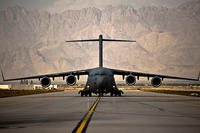
Despite the limitations noted by Eccles two ADS 1200 systems and their 7-man civilian crew was flown from the Phoenix International facility in Morgan City, Louisiana to Russia last week by a Mississippi Air National Guard C-17 crew as part of the international effort to rescue the trapped submariners. Phoenix International holds a number of multi-year contracts with the Navy for ship repairs, search and recovery, and submarine rescue equipment construction. Although the ADS divers – called pilots – weren't needed, they had the capability to find and aid in the rescue of the AS-28 had it become necessary, Jainatis said.
"We assisted Navy divers during the Columbia Space Shuttle disaster, search and recovery operations all over the world, and working with the Navy on the new SRDRS," Maclin added. "Because SRDRS was not in place to respond to the accident we used the ADS 1200. The [US Navy] Supervisor of Salvage [and Diving (SUPSALV)] directed us to use the commercial system, to send it to Russia ."
The civilian versions of the ADS deployed with the seven-man Phoenix crew are forerunners of the Navy's new units and are capable of diving to 1,200 feet and remaining there for up to eight hours, Maclin said. The suit has a sonar capability to help it locate the sub and is equipped with an air, hydraulic and electrical umbilical cable and can use hydraulic and electrical power pack operated tools such as grinders and cutters.
The suits used in Russia were equipped with three cutting tools including a grinder, a "hudsky" cutter and a tugger. The cutter can cut up to about 2 inches of steel cable. A limited lift capability is also being deployed with the suits, the Navy said.
Lt. Col. Jim Conway, the 183d Airlift Squadron operations officer at the 172d Airlift Wing who helped plan the epic flight said the entire weight of the two ADS units and their attendant equipment was a staggering 95,000 pounds - or about 5 tons more than the Mystic weighs.
"When the Navy deploys its version of the ADS system its pilots will be able to descend to 2,000 feet, although the Navy doesn't foresee and close working relationship between the ADS pilots and the current DSRV."ADS is not designed to rescue personnel from a disabled submarine," Eccles said.

DSRV Mystic being loadad aboard USS LaJolla . during Operation Pacific Reach 2004 Photo: USN |
|
Meanwhile, the Navy maintains the Mystic and two SRCs that can rapidly be transported to a support vessel to be used at the location of a disabled submarine. The SRCs can be mated to a disabled submarine by using a "down-haul" cable attached to a special pad-eye on all U.S. submarine hatches. Although they are limited by depth restrictions they are lighter and easier to move around than the DSRV. In addition, the SRC and its systems can be placed aboard more than 4,000 commercial vessels capable of supporting the SRC's rescue mission. The Navy hopes to have at least part of the SRDRS in place and available for rescue missions by 2006, Maclin said. Currently the Navy, in conjunction with Phoenix International and OceanWorks International , a Vancouver, Canadian Shipbuilding Company that is developing the new deep submergence rescue system, is moving as fast possible to complete the project before the Mystic is decommissioned. The SRDRS rescue vehicle is capable of descending to depths of up to 2,000 feet and can accommodate up to 18 rescuees in a single dive, Maclin said.
When the SRDRS is deployed it will offer many life saving qualities that simply don't exist in the SRC and have a limited capacity in the DSRV. Of particular interest to submarine crews who must face the agony of the bends if exposed to normal surface air pressure before their bodies are purged of nitrogen is the SRDRS decompression system and the articulated docking skirt that allows it to attach to a submarine lying at acute angles, the retired skipper said.
Both the SRC and DSRV leave the rescued crews exposed to potential danger from the dreaded "bends" if they are exposed to normal air pressure before they can be hustled into decompression chambers on board the mother ship or MOSUB. The SRDRS is designed to seamlessly move the "recuees" from the rescue vessel to the decompression chamber using the Submarine Rescue Vehicle ( SRV ) "Hyperbaric Transfer System" docking mechanism. The transfer system mates the hatch of the SRV to the decompression chamber without exposing the survivors to outside atmospheric pressure, Maclin explained.
 |
|
"There are some good things about it: the DSRV was built on a presumption that people inside a stranded sub would remain at sea level pressure. This may not be accurate. Given an influx or water they might be at a higher pressure. Safely transferring them and then decompressing them is important," the skipper said. "DSRV was not built to do that. The ADS was built to overcome the limits of saturation diving. It does that well. The result of combining both capabilities was an application to sub rescue and an advance in rescue safety."
Ultimately, fate will play as big a role in the future safety of American submariners as rescue capabilities, the retired skipper said. In the last ten years the Navy has witnessed several major submarine accidents, culminating with the USS San Francisco slamming into an undersea mountain near Australia earlier this year. ( See Perry's series on the USS San Francisco incident) Industrial safety experts will tell you that this progression portends a major disaster waiting to happen and that isn't even considering the potential for a protracted war against an enemy with a capable undersea force, the skipper warned.
"There is a progressive growth of transfer of military stuff to civilian manning," he added ominously. "There is a presumption that civilians do it cheaper in the long run (Congress complains of things like retirement benefit costs and such). Probably true, but the finance system faced with the grind of lower funding from Congress somehow presumes that submarines will only require rescue in non-combat situations. After all we haven't really had a [submarine] war for how long?"
©2005 DefenseWatch.Contributing Editor Nathaniel R. "Nat" Helms is a Vietnam veteran, former police officer, long-time journalist and war correspondent living in Missouri . He is the author of two books, Numba One – Numba Ten and Journey Into Madness: A Hitchhiker's Account of the Bosnian Civil War, both available at www.ebooks-online.com . He can be reached at natshouse1@charter.net . Send Feedback responses to dwfeedback@yahoo.com . All opinions expressed in this article are the author's and do not necessarily reflect those of Military.com.
|