

















|
|
|
|
SOUND
OFF! |
| Join our
discussion here.
| | |
| Bush Seeks Massive Defense
Hike
Christian Science Monitor January 29, 2002
Not
since the Reagan administration charged into Washington, pledging to
repair a "hollow" Army while confronting the Soviet "evil empire" around
the world, has the US defense budget been such a rocket-hot issue. In
terms of size, disposition, and politics, it is likely to be at the
forefront of national debate through this election year.
In his
State of the Union speech tonight at 9 Eastern time, George Bush will lay
down his marker.
He wants the biggest increase in military
spending in 20 years. That is sure to involve difficult tradeoffs,
especially at a time of returning red ink in Washington. Mr. Bush also
wants to increase certain domestic programs - school spending and help for
the unemployed, for example - as well as cut taxes. On the military front,
he's still enamored of what could be a highly expensive missile defense
system.
But in the fight against international terrorism, Bush
says, "our military must have every resource, every weapon needed to
achieve full and final victory."
This means expanding and
equipping sophisticated and secretive Special Operations Forces. At the
same time, the shift to dealing with unconventional threats requires the
expensive training and posting of US forces in more places around the
world. All of this comes at a time of unprecedented uncertainty regarding
US national security.
A recent Pentagon report warns of "rapid and
unexpected changes" as well as "new geopolitical trends shaping the
world," including "a great deal of uncertainty about the potential sources
of military threats, the conduct of war in the future, and the form that
threats and attacks against the nation will take."
The war in
Afghanistan has spotlighted the value of small, highly mobile commando
units working with highly accurate - and highly lethal - weapons dropped
from the sky.
But it's also been a boost to the supporters of some
of the most expensive conventional weaponry: naval battle groups centered
on aircraft carriers, as well as long-range bombers and transport
aircraft.
In order to complete their assigned missions, each of
the services wants new gear. The Navy wants a new destroyer ($750 million
each); the Air Force, a new fighter jet ($180 million each); the Army, a
new armed reconnaissance helicopter and howitzer ($32 million and $23
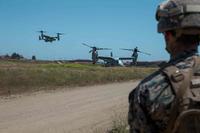
million each); and the Marine Corps, a new troop-carrying tilt-rotor
aircraft ($80 million each). Modernization continues
Bush's
defense spending blueprint continues the military modernization begun
under former President Clinton, provides for a pay raise, and includes a
$10 billion war reserve to continue the fight against terrorism (which has
been costing about $1 billion a month).
In all, it amounts to a 14
percent increase over current spending (a $48 billion boost to a total of
$379 billion). That's the largest annual increase since former President
Reagan's first year in office and a total matching the Pentagon budget
during the height Vietnam War.
Defense Secretary Donald Rumsfeld
acknowledges the logic of drawing down US military forces and weaponry
when the cold war ended. "But the problem is, it overshot," he said last
week. "It went too far, and there was a [weapons] procurement holiday that
was way too long."
But a pledge to provide "every resource, every
weapon" sought by the generals and admirals raises a major question: Can
the Bush administration efficiently and effectively spend that kind of
money while also bringing about the kind of military transformation that's
needed in the 21st century?
While all the details are yet to be
known - not to mention what Congress will do to the president's proposed
Pentagon budget - it appears to many experts that the administration is
avoiding the kind of hard choices that candidate Bush promised during the
campaign.
"They are giving the services essentially everything
they want - not a way to encourage greater efficiency on the part of any
organization," says Michael O'Hanlon, a defense analyst at the Brookings
Institution in Washington.
All of which raises questions about
pork and the storied "iron triangle" of Pentagon brass, defense
industries, and their champions in Congress - especially at a time when
the administration is projecting a return to red ink with a budget deficit
this year of $106 billion.
"The current $350 billion total is
already more than enough to fight the small- to medium-scale conflicts
overseas - such as the war in Afghanistan or even a larger campaign
against Iraq - needed to combat terrorism," says Ivan Eland, director of
defense policy studies at the Cato Institute in Washington.
"The
United States is already more dominant militarily vis-à-vis the rest of
the world than the British and Roman Empires at their zenith."
Earlier this year, Mr. Rumsfeld promised to take on the military
establishment and push reform. No reform after 9/11
The events
since Sept. 11 could make that all the more difficult.
"Rumsfeld
has said his top priority is defense transformation, yet he submitted a
budget which does not point the way to change at all," says Larry
Seaquist, a former Navy warship captain and Pentagon strategist.
"We haven't seen the details yet, but it appears that they just
plan to pour more fertilizer on the same old crops."
"I remain
hopeful that Rumsfeld and [Deputy Secretary of Defense Paul] Wolfowitz,
who are very savvy, very experienced defense policy generals, are serious
about overhauling the Pentagon," adds Mr. Seaquist.
"They may be
just too busy with Afghanistan right now to plunge into the transformation
fight."
Copyright 2002 The Christian Science
Monitor. All rights reserved.
|
Copyright 2006 . All rights reserved. This material may not be published, broadcast, rewritten or redistributed.
|