





'The Entire Island
Is a Shrine'
By Colonel John W. Ripley, U.S. Marine Corps (Retired)
Naval History, February 2005
COURTESY OF WORLD WAR II 50TH ANNIVERSARY COMMITTEE
The Navy Cross recipient climbed Mount Suribachi in November 1987,
more than 15 years after his heroic destruction of the bridge at Dong
Ha during the Vietnam
War. To commemorate the 60th anniversary of the Battle of Iwo Jima,
we present this poignant letter he wrote then to his friend, Ross Mackenzie.
Colonel Ripley is scheduled to revisit Iwo
Jima in February 2005 and has agreed to report from the anniversary
commemoration there for Naval History.
17 November 1987
Dear Ross,
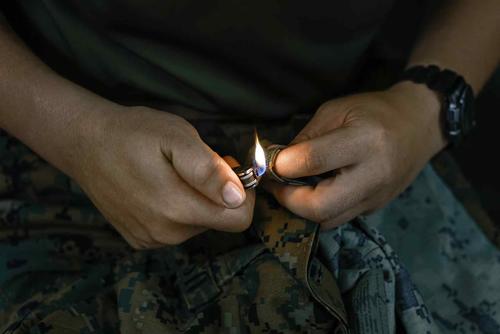
From this most unlikely spot I am inspired
to write you for reasons I can't fully explain. Certainly you have received
no other letters from here I would wager, and you may find this interesting.
It's the middle of the night-cold, windy, uncomfortable & profoundly moving.
I'm looking down on a tiny island three miles wide and five miles long.
Down there, and here where I'm writing by flashlight, over 7,000 Marines
died. The mountain is Suribachi, the island, Iwo Jima. Of the hundreds
of thousands of words written about this place, nothing comes close to
describing its starkness, its inestimable cost and now, sadly, the poverty
of its abandonment.
The entire island is a shrine, mostly Japanese, but a few American-only
a few. Americans don't seem to care about such things when, as is the
case here, it's inconvenient. And yet this island, its name and most especially
this very spot where I sit-where the flag was raised-are immortalized
in our national consciousness for as long as there is an America.
The debris and detritus of war remain even after nearly 43 years. Rusty
vehicle hulks, wrecked boats, sunken ships, canteens, mess kits, thousands
of rounds of corroded ammunition, blockhouses, pillboxes, trenches, abandoned
airfields, large naval shore guns, artillery, etc. And beneath my feet
remains of 22,000 Japanese defenders, brave men who died at their posts;
hated then, respected now.
Rupert Brooke said it perfectly: "Here, in some small corner of a forgotten
field, will be forever England." And this brutally stinking sulfuric rock,
depressing to see, demoralizing as it has lost its once vital importance
and our nation's once great concern, will be forever America. It will
be forever in the memory of those 75,000 Marines who fought here, the
25,000 who suffered wounds here and the 7,000 who gave their blood and
lives to its black soil. Again Rupert Brooke: "In that rich earth, a richer
dust concealed." Their hopes, their happiness, their dreams ended here.
And if we fail to honor them in our memory and our prayers, we should
be damned to hell for such a failure.
 |
| COURTESY OF AUTHOR |
I brought a small team here to survey the island for future exercise use.
The Japanese would prefer we did not exercise here, but that will be over
my dead body. I find it hard to believe (and impossible to accept) that
our government gave the island back to them. It's as if we gave them Gettysburg
or Arlington National Cemetery. Americans died in such numbers here that
in 9-1/2 months, had the battle lasted that long, it would have equaled
our losses of 10 years in Vietnam.
The Marine Corps must never lose its right to exercise here and I'm damned
proud of having something to do with assuring that it will be so.
Yours aye,
John
| Join
the Naval Institute, a membership association for Navy,
Marine Corps, and Coast Guard professionals and anyone interested
in the sea services. Benefits include a subscription to Proceedings
magazine, discounts on books, magazines and gifts, and access to
the world's largest private ship and aircraft photo library. |
© 2005 U.S. Naval Institute. All rights reserved.