




















 |
| Satellite
photo of Lingshui Airfield taken 10 April (SpaceImaging.com) |
|
|
|
SOUND OFF!
|
| Join our discussion
here.
|
|
|
|
Downed U.S. Spy Plane May Have Used Shredders,
`Disk-Mashers'
New York Times Syndicate
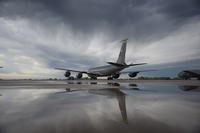
If the crew of the US Navy spy plane held by
China managed to destroy any on-board secrets, it may have been with
the help of a Westborough, Mass. shredding company.
The company is Security Engineered Machinery, or SEM, which makes
high-powered paper choppers and computer disk mashers for US military
and intelligence agencies. The Navy won't specify what equipment was
on board the EP-3E surveillance plane, but company executives have
reason to believe it was theirs.
SEM says the naval air station that was home base for the plane's
squadron, on Whidbey Island in Washington state, has been a major
customer for its products. These include a ``degausser'' wand that
uses a strong magnetic field to wipe clean any disk brought within
several inches of it, and a shredder that chops paper into bits no
bigger than 1/3 of an inch. That would be too small for any outsider
to reconstruct.
``More than likely they're on that aircraft,'' said Leonard Rosen,
chairman and founder of closely held SEM. ``We know for sure they're
using our equipment somewhere,'' he said, of the plane's squadron.
Rosen and other SEM officials have no direct knowledge of what actions
the EP-3E crew may have taken to destroy sensitive data after their
aircraft collided with a Chinese F-8 jet fighter and was forced to
make an emergency landing at a Chinese air base on Hainan Island.
The accident mushroomed into an international crisis over the past
week, with the Bush administration demanding the return of the 24
crew members and the plane, and the Chinese government demanding an
apology.
In the shadowy world of data-destruction, SEM has assembled quite
a following. Founded in 1967 to make high-powered paper shredders,
it has evolved with the technology revolution and lately has begun
selling various equipment for rendering useless computerized data
as well. The company now has about 35 employees and expects revenue
of around $10 million this year.
For most if its history, it has supplied devices to dispose of sensitive
military and diplomatic documents and other material. Some models
use stainless-steel blades attached to high-speed rotors; one version
needs just an hour to chew through 450 pounds of books or videotapes.
That capability - and various military approvals - also drew SEM into
contact with civilian agencies, and several years ago Rosen and president
Peter Dempsey began making plans for a major expansion into the commercial
markets as well. Software-makers, for instance, often destroy old
inventories of computer disks, to prevent their entering the black
market. SEM's equipment has also been used by the Federal Reserve
system to destroy old banknotes.
But Dempsey said military sales have remained the company's primary
line of business. In the mid-1990s, it developed a ``declassifier''
that sanded off the surface material from CD-ROMs and left only a
powder.
The technique met a military security standard, but customers wanted
a more versatile machine that could be used to render all sorts of
optical disks useless as well.
Now SEM is about to start shipping its answer: the Model 1250/B. Internally
it resembles a waffle iron and uses metal dies to indent marks onto
the disk's surface. SEM says the new pits will throw off any laser
trying to read information.
Another advantage over the previous method, Dempsey said, is that
labels don't need to be peeled off. The new machines will sell for
about $3,500, or $1,700 less than the previous models. Dempsey figures
to sell 500 of the new version this year, or roughly as many as SEM
has sold of the previous model to date.
Dempsey said his company's equipment has also become popular with
defense contractors who use it to destroy drafts of sensitive proposals.
``You can't get contracts without shredders these days,'' he said.
-----
(The Boston Globe's Web site is at http://www.boston.com/globe.)
c.2001 The Boston Globe
|