
|
|
|
 |
| A member from the crew of the United States
EP-3 aircraft involved in an accident with a Chinese F-8 aircraft
arrives at Andersen Air Force Base, Guam. He is greeted by Adm.
Tom Fellin, commander, U.S. Naval Forces Marianas, on April 12.
(U.S. Marine Corps photo by Gunnery Sgt. Blair A. McClellan) |
|
|
|
SOUND OFF!
|
| Join our discussion
here.
|
|
|
|
Crew disputes Chinese
account, Bush rakes Beijing
Associated
Press April 12, 2001
WASHINGTON (AP) - Navy fliers returning Thursday from 11 days of detention
disputed China's account of the collision that brought down their surveillance
plane. President George W. Bush said "tough questions" would be put
to China at an inquiry next week.
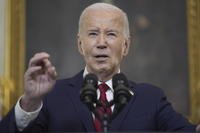
His tone stern, Bush said at the White House, "The kind of
incident we have just been through does not advance a constructive
relationship between our countries."
Through most of the
protracted negotiations that freed the crew but not their aircraft, Bush
had approached Beijing with diplomatic care, insisting the surveillance
was legal but also approving expressions of sorrow the Chinese pilot was
lost and the American plane did not seek approval for its emergency
landing after the April 1 collision.
But after crew members told
debriefers they were on a "fixed course" and had not swerved into the
Chinese jet fighter, as Beijing contended, Bush stood in the Rose Garden
and let loose, castigating not only the detention of the 21 men and three
women, but China's record on human rights, religious freedom and stability
in the Asia-Pacific region.
"The United States and China will no
doubt again face difficult issues and fundamental disagreements. We
disagree on important, basic issues," he said.
Referring to a
scheduled joint meeting next Wednesday on the collision, the disposition
of the Navy plane and related issues, Bush said: "I will ask our United
States representative to ask the tough questions about China's recent
practice of challenging United States aircraft operating legally in
international airspace."
Reconnaissance flights, he said, "are a
part of a comprehensive national security strategy that helps maintain
peace and stability in our world."
In diplomatic exchanges over
the incident, Bush said, "the United States and China have confronted
strong emotions, deeply held and often conflicting convictions and
profoundly different points of view."
A few hours earlier, a
senior Pentagon official told The Associated Press the Americans were
flying level and were on a fixed course at fixed altitude when the Chinese
plane struck the U.S. aircraft.
With the crew safely back on
American soil in Hawaii, Bush said, "China's decision to prevent the
return of our crew for 11 days is inconsistent with the kind of relations
we have both said we want to have."
"From all the evidence we
have seen, the United States aircraft was operating in international
airspace, in full accordance with all laws, procedures and regulations and
did nothing to cause the accident," he said.
Bush, who spoke with
crew members before making his statement, said they "did their duty with
honor and great professionalism."
Only a few hours earlier, the
White House spokesman Ari Fleischer had said the U.S. relationship with
China was on a productive course.
But China's Deputy U.N.
ambassador, Shen Guofang, told The Associated Press in New York, "We have
to make further investigations on the plane and also to have consultation
on their further activities along our coastal areas."
He said
investigations of U.S. flights "will take some time," and he described
the April 18 meeting as one of experts, thereby suggesting it would not be
conclusive.
"We have to convince the Americans that if they have
further activities like this along our coastal areas, it is not in the
interests of both countries and it is very dangerous for them, because
maybe in the future, I'm not sure whether this kind of collision will
happen again if they still will carry out spy activities like this," Shen
said.
Meanwhile, the crew landed in Hawaii to cheers and to face
two long days of debriefing before weekend reunions with families and
friends.
"We're definitely glad to be back," said Lt. Shane
Osborn, the mission commander, in a statement to officials and military
families.
"I'm very pleased they are back on American soil,"
Secretary of State Colin Powell said Thursday in Paris.
Bush was
having lunch at the White House with Vice President Dick Cheney when the
plane carrying the crew arrived in Hawaii. The president looked up at
television reports of the arrival and told Cheney, "Good news. Welcome
home."
For Bush, still enmeshed in his first major overseas
squabble, handling of the diplomacy with China was testing his support at
home among political conservatives.
The dispute was giving impetus
to a bill to overturn last year's law paving the way for China to gain
permanent normal trade relations with the United States.
"This
incident calls into question our current policy of sending American trade
dollars to a nation that has displayed signs of hostility toward the
United States," said Rep. Duncan Hunter, who proposed the measure to
overturn the trade law.
"The Chinese didn't act in a normal way,
so it brings the trade deal under greater scrutiny," said Rep. Spencer
Bachus, who voted for the trade bill but now has his doubts. "The jury is
still out on whether we would approve an extension."
Condoleezza
Rice, Bush's national security adviser, indicated that Bush would not
yield. "I think we all believe that trade with China, the effort to try
and build an entrepreneurial class in China, to try to bring some freedom
to that society through freer economics, is an important goal," she said
on CBS' "The Early Show."
Copyright 2001
Associated Press. All rights reserved. This material may not be published,
broadcast, rewritten, or redistributed.
|
|
|
|
|